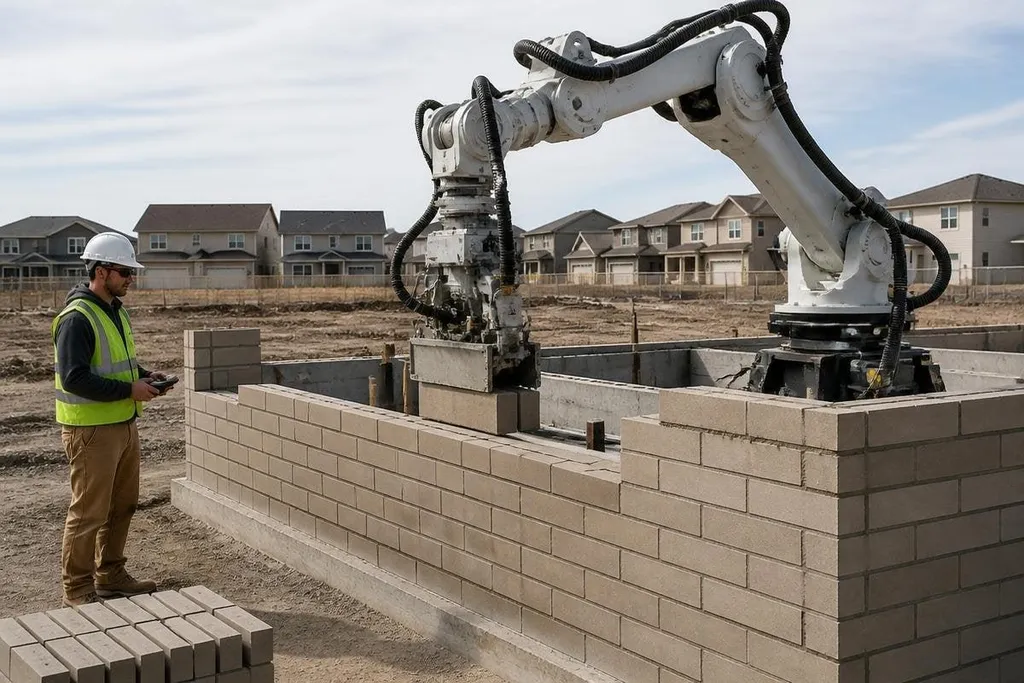
A housing shortage has two separate problems: too few homes and too much time, labor, and money needed to build them. Robots can help with parts of the construction process, but they can’t create land, approve permits, or lower borrowing costs.
- Robotic tools can place bricks, print concrete walls, move materials, and inspect work.
- Factory-built panels can shift more construction indoors, where machines work in repeatable conditions.
- The hard limit is the wider housing system, not the robot arm alone.
Where robots can help
Construction robots work best on tasks that repeat often and follow a clear path. A bricklaying system can pick up units, add mortar, and place them along a programmed wall line. A concrete printer can lay wet material in measured layers to form walls or other parts of a building.
Those machines can reduce the amount of manual handling on a site. They may also keep workers away from some heavy or repetitive jobs, while people handle setup, inspection, repairs, and work that changes from one room to the next.
Factories offer a different route. A company can build wall panels, floor sections, or bathroom modules indoors, then send them to a site for assembly. Robots can cut, drill, fasten, and inspect these parts in the same work area each time.
That repeatability matters because rain, poor lighting, and crowded sites can slow outdoor work. The gain depends on the building design. A robot needs clear instructions, known materials, and enough repeated work to cover its purchase and setup costs. A custom house on a difficult site gives a machine fewer chances to repeat the same motion.
The parts a robot cannot fix
Housing supply depends on more than the act of construction. A project still needs land, planning approval, utility connections, financing, materials, skilled supervision, and a buyer or tenant. Faster wall work leaves the other steps unchanged.
Building codes can also limit how a machine works. Local rules may require inspections at set stages, specific materials, or construction methods that a new automated system has not yet used often. Each change in design can require new software, tools, training, and safety checks.
The labor question is more difficult than replacing one worker with one machine. Construction still needs people who can prepare a site, connect services, check structure, fix errors, and respond when the plan meets an unexpected condition. A robot may move the labor need rather than remove it.
Cost matters too. A machine can reduce labor on one task while adding costs for transport, maintenance, programming, and site preparation. A factory can make production more regular, but a factory also needs steady orders. Without enough projects, its equipment may sit unused.
A robot-built house still needs a measured build time, labor count, and total project cost. A report at Robot 24 can place those figures beside the machine, site, and company named in the project. Those details give the next section a practical test: which building tasks can the approach handle at a lower cost?
What would make the approach useful
Robots have a better chance in housing projects with repeated floor plans, controlled work areas, and a steady flow of similar parts. Apartment blocks and planned developments fit that pattern more closely than one-off homes spread across difficult sites.
The design must also start with the machine in mind. Builders may need to change wall joints, panel sizes, access routes, or material choices so a robot can reach the work. That can reduce some manual tasks, but it may also narrow the range of designs a project can use.
Proof should come from completed buildings, not a short demonstration. A useful test would show how long the system worked, how often people had to intervene, how much material it wasted, and what happened when a part did not fit.
A practical test for a housing project
Before buying or backing a construction robot, check these points:
- Name the repeated task. Define the exact work the machine will do and how often it appears in one project.
- Measure the full cost. Include setup, transport, software, maintenance, training, and repairs alongside the machine price.
- Check the site. Confirm that the robot has enough space, power, shelter, and safe access to each work area.
- Plan for errors. Set out who checks the work and who fixes a bad placement, blocked route, or failed tool.
- Count human work. Include the people needed to prepare materials, supervise the system, inspect results, and finish the building.
I'd treat robots as a construction aid, not a housing policy. They can remove some slow work from the building process, but the shortage remains if approved land, finance, materials, and trained crews are still missing.
The useful question is narrower: which housing projects repeat enough work for a machine to lower the cost without adding a new layer of delay?